
Litterless Lunch Study

Good for Pocket Book
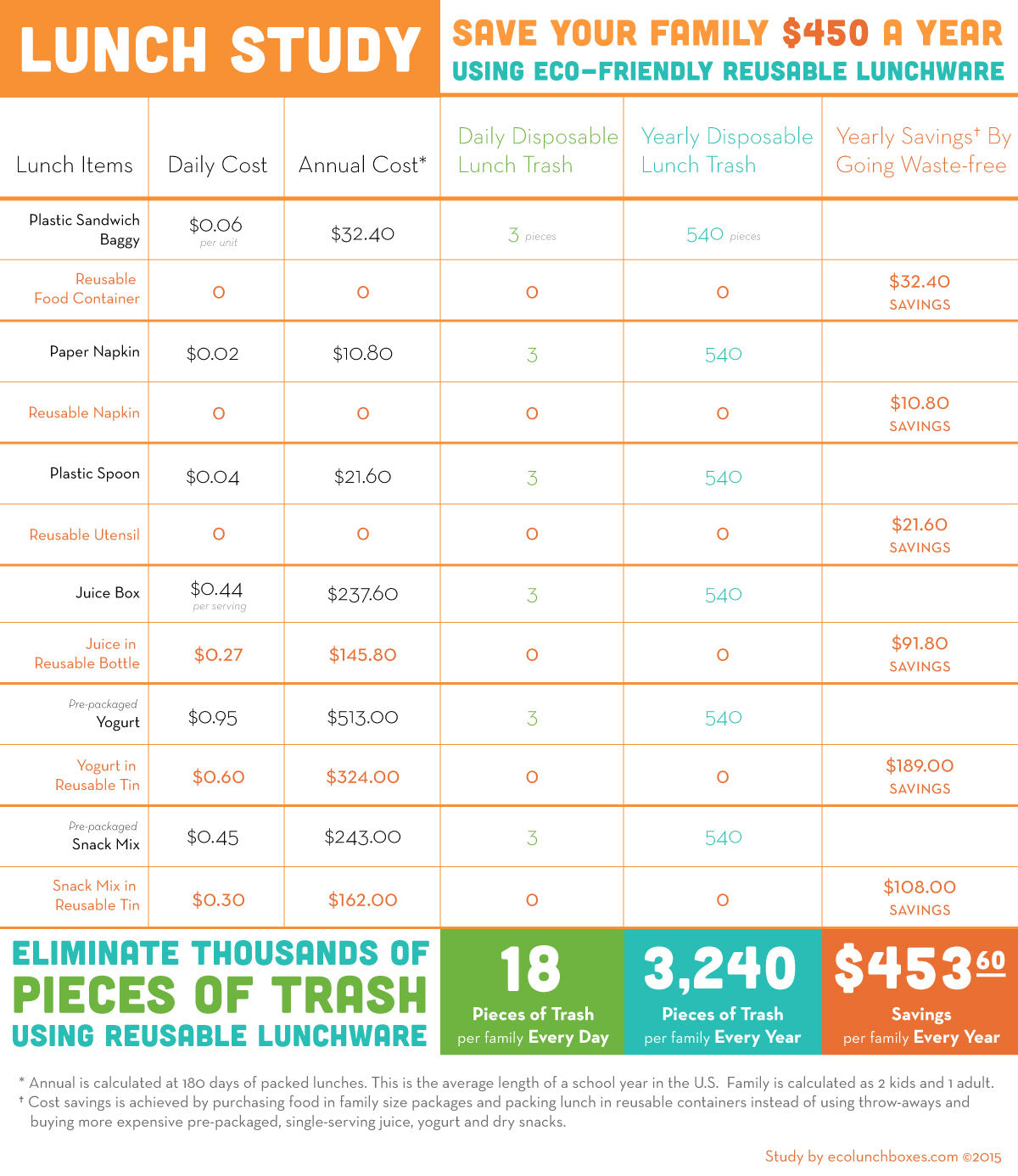
If your family is using single-use, disposable items like brown paper bags, plastic baggies and pre-packaged drinks to pack lunch, you’re probably wasting about $450 a year.
“We know green lunches are healthy for people and the planet, but the results of our study strongly show that our pocketbooks are big winners, too,” says Sandra Harris, president and founder of ECOlunchbox.
"No matter how you look at it, going waste-free at lunchtime is a big winner." We did the math, and analyzed the cost to determine the difference between packing throw-aways and single-serving foods versus buying juice, yogurt and dry snacks in family size quantities and packing these foods in reusable lunch containers.
 Here’s how we did it.
First our team determined the cost of each of the food items when purchased with individual-portion, pre-packaging and without. For example, if a family buys juice boxes the cost per serving is 44 cents compared to 27 cents per serving for juice purchased in a larger bottle and packed for lunch in a reusable drink container.
In another example, plastic baggies for sandwiches cost approximately 6 cents each. That's 6 cents that goes into the trash everytime this throw-away is used. Alternately, packing a sandwich in a reusable food container generates no waste and no daily money thrown away into the trashcan.
For the purposes of our analysis, we also defined a "typical family" as 2 children and 1 adult lunch packers; and we assumed that families would likely pack lunches 180 days a year, which is the number of days in a typical school year.
Check it out! After we ran the numbers, it was very clear that investing in reusable, plastic-free lunch containers was the clear winner in terms of overall, long-term cost.
However you pack your lunches, we hope our litterless lunch study helps you think about your lunch in a new way - in terms of dollars and cents!
Good for People
Doctors and researchers have linked BPA in numerous studies to hormone problems, behavior issues, obesity, cancer, diabetes, and even kidney and heart conditions.
Chemicals in plastics are perilous to human health because they are endocrine disrupters and hormone mimickers. These toxins are also harmful to the environment, because less than 4% of plastics internationally are recycled, with the remainder of discarded plastics put in landfills or lost in the environment and will never biodegrade.
Good for Planet
The best way to reduce garbage is to not create it. A waste-free lunch (sometimes called a litter-less, smart, garbage-less, waste-free, no-garbage or waste-not lunch) means that you have no packaging to throw away when you're done. All you’re left with is apple cores, banana peels and other biodegradable extras.